
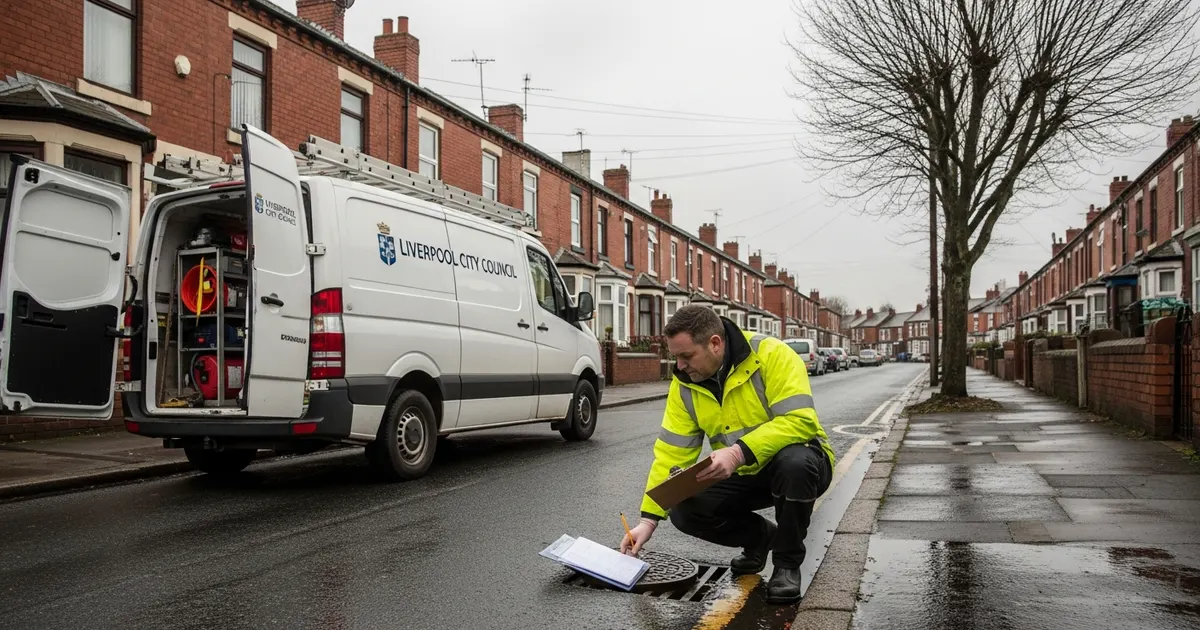
Huyton and Knowsley sit at the eastern edge of Merseyside, and they reward the drainage engineer who takes the time to understand them. This is not a single housing era or a single soil type. Within a few streets of each other you can move from a post-war council estate with original pitch fibre, to a 1990s private development on made ground, to a 1960s semi with shared clay drainage that has never been surveyed.
At Blocked Drains Liverpool we attend jobs across Huyton and Knowsley several times a week. This guide sets out what we most commonly find, where we find it, and what homeowners and landlords should understand about their drainage before something goes wrong.
The Housing Stock in One Overview
The dominant housing character of Huyton and Knowsley is post-war public sector — large council estates built from the late 1940s through to the early 1970s. The drainage that went in with them was pitch fibre in most cases, sometimes 100mm grey uPVC in the later builds, often laid to shallow falls and draining to central manholes on each street.
Alongside this are the older ribbons of development: Huyton village centre with interwar and Edwardian semis and terraces along Huyton Lane, Derby Road and Twig Lane, plus the Prescot Road corridor with mixed residential and light commercial use. Then there are the newer private estates in Knowsley Village, Tarbock, and along the A57 — 1980s to 2010s builds with uPVC pipework.
Page Moss and Stockbridge Village
Page Moss is the largest of the post-war estates in the area, built predominantly in the 1950s and 1960s with drainage almost exclusively in pitch fibre. On the oldest Page Moss streets, we find pitch fibre at 40 to 50 per cent of its original bore. A toilet flush that would have passed freely in 1965 now sits in a pipe barely wider than a tennis ball in its flattened dimension. The result is recurring blockages, slow drainage after heavy use, and an unpleasant smell during warm weather.
The remedy options are pipe relining or excavation and replacement. We covered that choice fully in our guide to pipe relining vs excavation. On Page Moss, lining is usually the preferred route: the streets are adopted, excavation means highway reinstatement costs, and the original pipe, even deformed, is generally still sound enough to host a liner.
Stockbridge Village, developed slightly later and extending into the 1970s, has a mix of pitch fibre and early uPVC. The joints between pitch fibre runs and later uPVC repair sections are a recurring failure point. We find offset joints and small root entry points at these transitions constantly on CCTV survey.
The Prescot Road Corridor
Huyton's main arterial road carries predominantly salt-glazed clay drainage, considerably older than the post-war estates. The characteristic problems are joint displacement from cumulative ground movement, root intrusion from the mature street trees, and the occasional complete collapse of a section that has been carrying a slow crack for years. For any Prescot Road property with a recurring blockage or slow drainage, the sensible first step is a CCTV drain survey to establish the condition of the entire run.
Huyton Village Centre
The village centre is a different character from the estates. Some of the terrace rows here date to the mid-Victorian period with clay drainage not surveyed since the 1940s. Huyton village is also one of the areas where we most frequently find tree root ingress to be the defining problem. The mature trees on some of the older streets are within 3 to 5 metres of drain runs, and their roots have been finding the clay joints for decades. We wrote a detailed guide to tree roots in drains that sets out the full remediation options.
Knowsley Village and the Newer Private Builds
Knowsley Village is a planned settlement developed progressively from the 1990s. In practice, we see three recurring issues: subsidence on made ground creating reversed pipe gradients; adoption status uncertainty on private estate shared drains (covered in our guide to United Utilities and drain ownership on Merseyside); and an age issue on 1990s-era uPVC push-fit joints that have been moving for 25 to 30 years.
United Utilities Responsibilities in This Area
The Huyton and Knowsley area falls within the United Utilities operational zone. Since October 2011, United Utilities has been responsible for adopted lateral drains. In an area like Page Moss or Stockbridge Village, repairs to the shared run are United Utilities' liability, not yours. Call them first if you believe the blockage is in a shared section.
If you have a drain problem in Huyton or Knowsley — recurring blockages, slow drainage, sewage odour in the garden, or a backup into the property — request a quote online from Blocked Drains Liverpool. We will provide an honest assessment of whether the problem is yours or United Utilities', and quote clearly before we start. We cover Huyton, Knowsley and surrounding areas seven days a week.